Finding the right typography often means looking beyond the industry standard. Helvetica has dominated graphic design for decades, but its ubiquity and high licensing costs push many designers to seek alternatives. When searching for fonts similar to Helvetica geometric sans-serif alternatives, you are usually looking for a typeface that maintains a clean, objective Swiss design aesthetic while introducing the mathematical precision of a geometric structure. Understanding this distinction helps you pick a font that actually fits your project instead of just grabbing the first free download you see.
What is the actual difference between Helvetica and a geometric sans-serif?
Helvetica is technically a neo-grotesque typeface, not a geometric one. Neo-grotesque fonts evolved from 19th-century grotesques, focusing on uniform stroke widths, horizontal terminals, and high legibility. Geometric sans-serifs, like Futura, are built on perfect circles, squares, and triangles.
Designers often blur these lines because they want the neutral, professional tone of Helvetica combined with the modern, friendly feel of geometric letterforms. Contemporary type foundries now create hybrid fonts that blend the structural rigidity of Swiss design with geometric proportions, giving you the best of both categories.
When should you swap Helvetica for a geometric alternative?
You should consider a switch when Helvetica feels too rigid or overused for your specific brand identity. Geometric alternatives work exceptionally well in tech branding, modern UI design, and large-scale display typography where the circular shapes add visual warmth.
If you are building a design system from scratch, exploring modern typeface options can save you from the heavy licensing fees associated with legacy fonts. A geometric hybrid also tends to perform better on low-resolution screens because the open apertures and wider character spacing prevent letters from blurring together at small sizes.
Which typefaces offer the best blend of Swiss neutrality and geometric structure?
Several contemporary fonts bridge the gap between neo-grotesque neutrality and geometric precision. Avenir is a classic example, designed by Adrian Frutiger to be a more humanist and readable take on the geometric style. It retains the clean lines of Helvetica but softens the strict geometry for better text readability.
For a more modern, digital-first approach, Manrope offers a fantastic middle ground. It borrows the vertical stress of neo-grotesques but uses geometric foundations for its lowercase letters. Reviewing the top choices for clean sans-serif pairing will help you match these primary fonts with complementary serifs or monospaced fonts for your secondary text.
What are common mistakes when replacing Helvetica in a design system?
The biggest mistake designers make is assuming a direct swap will work without adjusting the layout. Helvetica has a very specific x-height and character width. When you switch to a geometric alternative, the text block will expand or contract, breaking your grid.
Another frequent error is ignoring weight distribution. Helvetica’s bold weights are famously dense and heavy. Geometric fonts often struggle with heavy weights because the thick strokes close up the negative space inside letters like 'e' or 'a', making them look muddy. Always check the bold and black weights by comparing stroke widths and character spacing before finalizing your choice.
How do you test a new font before committing to a full rebrand?
Testing requires looking at the font in its actual environment, not just in a design mockup. Set up a staging page and type out real content. Check how the font handles punctuation, numbers, and special characters.
Pay close attention to tabular figures if your design includes data tables or pricing. Many geometric fonts use proportional numbers by default, which causes columns of prices to look jagged and misaligned. Ensure your chosen alternative includes a proper tabular number set.
Practical checklist for your typography switch
- Verify the font includes all necessary weights, especially a usable bold that does not close up the counters.
- Check for tabular figures and alternative glyphs if your project involves data or complex UI elements.
- Test the typeface on actual mobile and desktop screens to ensure the geometric shapes remain legible at 12px or 14px sizes.
- Adjust your line-height and letter-spacing in CSS, as geometric alternatives usually require slightly more breathing room than Helvetica.
- Review the licensing terms to confirm you have the right to use the font across web, app, and print mediums.
 Contemporary Geometric Alternatives to Helvetica
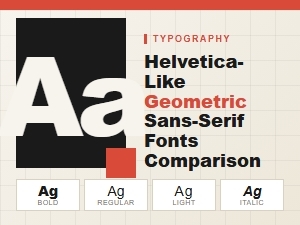 A Guide to Modern Geometric Sans-Serif Fonts
 The Top Modern Geometric Sans Alternatives
 Helvetica Versus Modern Geometric Sans Typefaces
 The Rise of Modern Geometric Sans Serifs
 Budget-Friendly Alternatives to the Classic Helvetica